Booking a mooring buoy in Cabrera isn’t complicated if you know exactly which steps to follow and which website to use. This article goes straight to what you need: the real booking windows, which buoy you get depending on your boat’s length, the rules that actually lead to fines, and what to do if you arrive and the quota is full.
If you already have a boat (your own, a bareboat charter or one with a skipper) and want to sail to the archipelago, this is what you need to know before leaving port. And if you’re still deciding whether to go on your own or find another way to enjoy that southern coast, you’ll find an honest answer at the end of the article too. For context on the area, our guide on what to see in southern Mallorca already places Colònia de Sant Jordi as the natural departure point for the archipelago.
The Cabrera archipelago has been a Maritime-Terrestrial National Park since 1991, which makes it one of the most protected natural areas in the Mediterranean. That protection has a direct consequence for anyone arriving by sea: free anchoring is completely forbidden in its waters. You can’t drop anchor wherever you like. If you want to stay overnight, or simply spend the day moored, you have to do it on one of the 50 official buoys provided in the harbour.
Those 50 buoys are the only authorised mooring point. There is no alternative anchorage and no tolerated free-anchoring zone. The park exists to protect the Posidonia seagrass meadows, the marine wildlife and the ecosystem as a whole, and that protection allows no exceptions. Put simply, it is one of the strictest access-management systems in the western Mediterranean.
If you want to understand why Cabrera has that reputation among people who sail in Mallorca, or why it appears in every guide to quiet places in Mallorca, the answer is right here: few boats, controlled access and untouched seabeds that also attract the dolphins that frequent this part of the Balearic archipelago, as we explain in our guide on where to see dolphins in Mallorca.
This is the most common mistake and the one that causes the most headaches: looking for the booking form on the website of Parques Nacionales, the national parks agency that reports to the Spanish Ministry, and finding nothing useful, or landing on a page that won’t let you complete the process.
Cabrera buoy bookings are handled exclusively through IBANAT, the Institut Balear de la Natura, an agency of the Balearic Government (Govern de les Illes Balears). You’ll find it in the specific section for the Parc Nacional de l’Arxipèlag de Cabrera on the Government’s online services portal. If you arrive from Parques Nacionales or from a search engine that sends you to the national government website, you’re in the wrong place.
Save the correct URL before you find yourself hunting for it in a hurry in high season. That small detail, which seems minor, can cost you the buoy: if you lose minutes looking for the form on the wrong website, the day’s quota may already be gone by the time you reach the right portal.
Applications open a maximum of 20 days before your arrival date. Not earlier. This means that if you want to moor on 15 August, the first window to apply for the buoy opens on 26 July.
In July and August the maximum stay is 2 consecutive nights. Outside high season the limit is longer, and there is also some kind of minimum interval between successive applications, but sources don’t agree on the exact details: confirm them in IBANAT’s current regulations, as they may have been updated between seasons.
The daily quota is limited and in high season it runs out quickly, sometimes within minutes of the portal opening. If there’s no buoy available for your date, your options are to try another day or to keep an eye on the portal in case places are released. We cover this in the section on cancellations below.
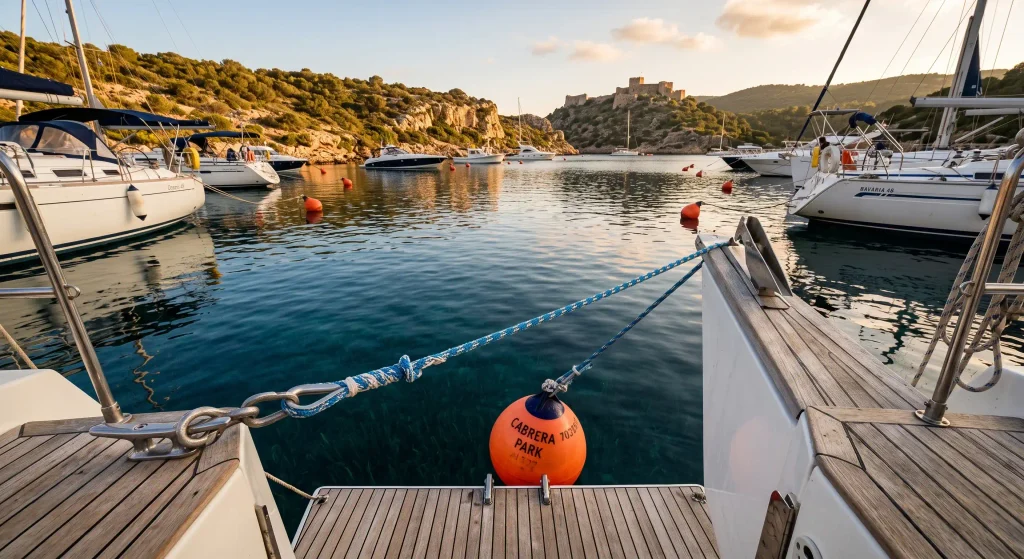
Of the 50 available buoys, 30 are allocated to private boats and 20 to charter boats. The distinction isn’t bureaucratic: it determines which quota you’re competing in and how many places there are for you.
If you’re sailing your own boat or a rented one with no commercial activity (including a bareboat charter for personal use, with no professional crew paid by passengers), you compete in the private quota. If the boat operates under a charter licence and carries passengers commercially, it belongs in the charter quota. Tick this box carefully on the form: a classification error can invalidate the booking.
In high season, private buoys usually run out before charter ones, so if you’re going in July or August it’s best to apply as soon as the 20-day window opens.
The system doesn’t let you choose a buoy freely. Allocation is automatic, based on the boat’s length overall, using an approximate colour system like this one.
| Buoy colour | Approximate length |
|---|---|
| White | Up to 12 metres |
| Yellow | 12 to 15 metres |
| Orange | 15 to 20 metres |
| Red | 20 to 35 metres |
Mooring a boat to a buoy that doesn’t match it, whether because it’s too big or because of a mistake in the application, is forbidden and can lead to a fine. If your boat is longer than 35 metres, you need special authorisation and prior justification; check your case directly with IBANAT before applying.
The process is entirely online. These are the steps and the documents usually required for this kind of procedure in maritime national parks. Before booking, check the exact form on the IBANAT portal, as the specific fields may vary from one season to the next:
It’s easier on a computer if you need to attach documents, although you can complete the process on your phone.
Arriving without knowing these rules can be expensive. These are the ones that most often lead to fines in protected areas like this one:
Not getting a buoy on the day the quota opens doesn’t close the door for good. Cancellations happen more often than you’d think (changes in the weather, mechanical problems or simply changes of plan) and those places go back into the system. If your chosen date shows as full, it’s worth checking the portal actively in the days beforehand, because there’s no automatic alert when places are released.
If the harbour is full and no released place appears, your options are limited. The waters immediately outside the park allow anchoring under certain conditions, but it’s essential to check the exact boundaries of the protected area on the nautical chart before dropping anchor: the line between park waters and open waters isn’t always obvious out on the water. The coves of southern Mallorca offer alternative anchorages on an equally protected coast, with far less traffic than you might expect.
These are the mistakes that come up season after season:
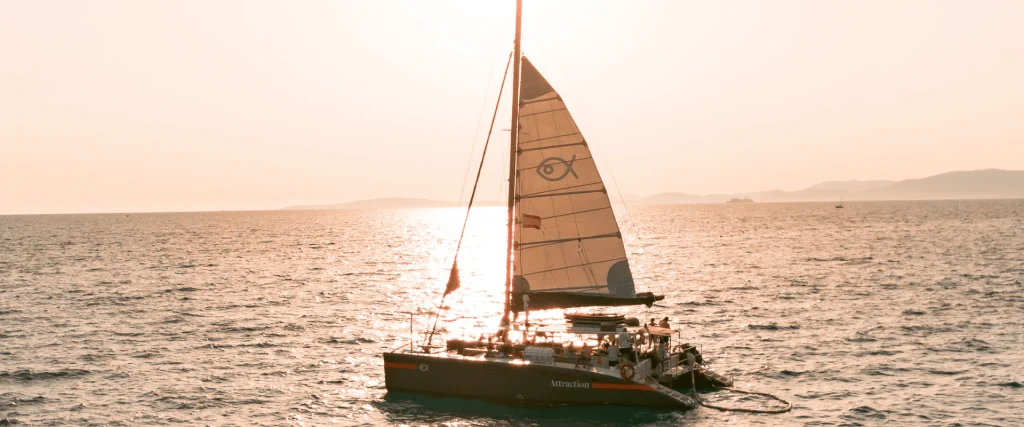
Everything above is useful if you have a boat and want to handle it yourself. But if you’ve come to this guide because you’re weighing up whether that logistics is worth it (the booking windows, the quota, the uncertainty of the portal), or if you’d rather reach that feeling of protected coastline, clean water and southern Mallorca without any of the paperwork, the route is different.
Mallorca’s Migjorn coast (Es Trenc and the southern coves) has that same character of a protected area, with clean seabeds and few boats. It isn’t Cabrera, and there’s no reason to pretend it is. But if what you’re looking for is a day at sea in the calm waters of the south without arranging the anchoring yourself, that does exist.
Cabrera is one of the most genuine corners of the Mediterranean, and the buoy system exists precisely so that it stays that way. The process has its complexities, but it’s manageable if you know where to do it, when to start and which documents to have ready. With this guide you now have the essentials. The rest depends on the weather, the quota and opening the portal at the right time.