If you’re reading this, you already know where you want to go. Es Trenc needs no introduction: kilometres of white sand, turquoise water and a protected natural setting that make it the wildest and most sought-after beach in southern Mallorca. What does need explaining is how to get there without the logistics killing the mood before you’ve even got your feet wet.
This article isn’t going to convince you to visit Es Trenc. You’ve already made that call. What you’ll find here is practical, no-frills information about the three real access options, how far you walk from each point, what to expect when you arrive and, at the end, an alternative that turns the journey into the whole plan for the day.
To reach Es Trenc beach, you have three possible routes: your own car, bus, or boat from Palma. Each one works well for a different profile.
The car is the most flexible option when it comes to timing, but it means dealing with the parking, which has limited spaces and seasonal pricing. The bus is cheap and sidesteps the parking problem, though it ties you to a schedule and adds a walk from the stop. The boat removes the overland friction entirely and turns the trip into part of the experience, albeit at a very different price point. Read on to decide which one fits you.
From Palma, the most direct route to Es Trenc is to take the MA-19 motorway south towards Llucmajor and Campos. Past Campos, you follow the signs for Ses Covetes or Es Trenc directly along the MA-6014. The total distance from Palma is around 55 km and the estimated time ranges from 45 minutes to an hour, depending on your starting point.
If you’re setting off from the south of the island, for example from Colònia de Sant Jordi, access is even simpler: about 15 minutes along a local road following the signs to Ses Covetes.
The final stretch, now on the MA-6014, runs between cereal fields and small salt pans until the parking signs appear.
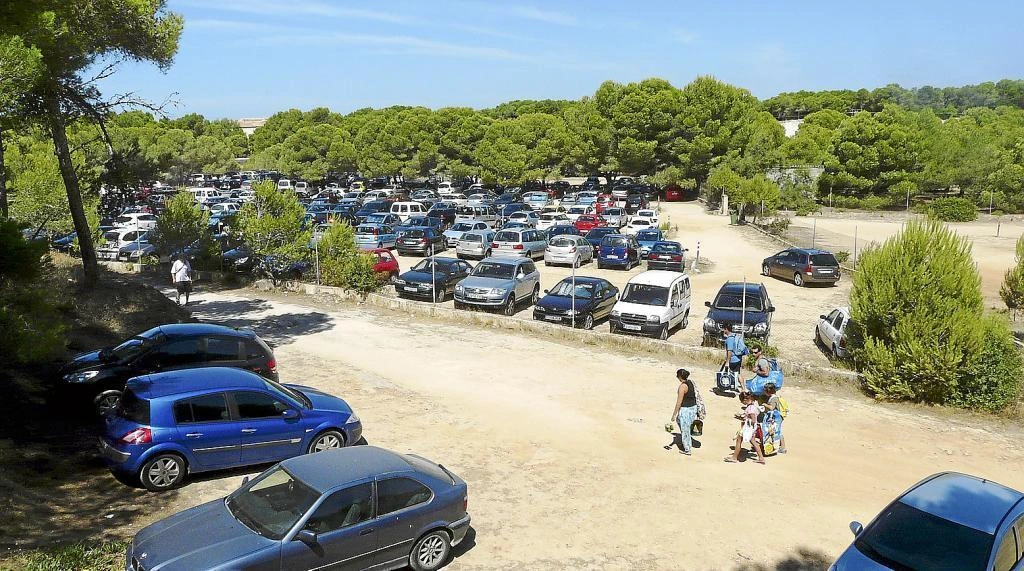
There are two main parking options when you arrive at Es Trenc: the Ses Covetes car park, at the western end of the beach, and the Es Trenc car park, more towards the centre. Both charge a fee, with rates that in high season run to around €8–12 per day, though it’s worth confirming current prices before you set off.
The reality is that on sunny days in July and August the car parks fill up before midday. It’s not a disaster if you arrive early or arrive late, but if you’re aiming to get there between 11:00 and 13:00, your chances of finding a space straight away are lower. The most common alternative is to park along the verges of the adjacent roads and walk a bit further.
The key thing: bring cash or check whether they take card, because in rural areas digital payment isn’t always guaranteed.
For those who prefer not to drive, getting to Es Trenc by bus is perfectly doable. The TIB (Transports de les Illes Balears) line 525 connects Palma with Campos, and from there there’s a connection towards the beach area. In season, more direct services also run that are worth checking on the official TIB website before travelling, since the timetables are updated each season.
The nearest reference stop to the beach is about 20–30 minutes on foot from the shore, depending on the exact access point. The path combines stretches of tarmac and dirt track, with no significant gradient, but under the summer sun it’s worth planning for: water, comfortable footwear and sun protection before you get off the bus.
The clear advantage: no parking, no sweaty walk back to the car, and the chance to combine the visit with a night in Campos or Colònia de Sant Jordi if the plan allows.
This is the question most searched for once access is sorted, and the answer varies quite a bit depending on your arrival point.
From the Ses Covetes car park to the shore it’s roughly 5–10 minutes on foot along a path of dirt and sand. It’s the shortest access. From the main Es Trenc car park, the distance is similar, though the path varies slightly depending on which part of the beach you’re after.
From the bus stop, the route is about 20–30 minutes’ walk, combining tarmac and compacted earth. It’s not a hard walk, but with cool boxes, parasols and small children it can feel long.
In every case, the last stretch to the water is loose sand, so a beach trolley rolls better than a cool box without wheels. A practical detail you’ll be grateful for on the ground.
Es Trenc has about 3 km of natural beach with no buildings on the front line, which makes it one of the few unspoilt stretches of coast left in Mallorca. The water is shallow at the shore and a turquoise that recalls the Caribbean more than the usual Mediterranean, thanks to the white sand seabed and the absence of posidonia near the shore.
Part of the sands has traditional naturist use, blended in without conflict alongside the rest of the beach. The atmosphere is calm and varied.
A few minutes away by car or bike are the Ses Salines salt flats, a protected natural area where, depending on the time of year, you can spot pink flamingos and other migratory birds. If your trip takes in more corners of the south, the article on what to see in southern Mallorca fills in the context of the whole area nicely.
Here’s the third route, and the most different of them all. If the question of how to get to Es Trenc overland has its nuances, the sea option removes them entirely: there’s no parking to sort out, no walk with the bags, no car waiting for you at the end of the day with the heat built up inside.
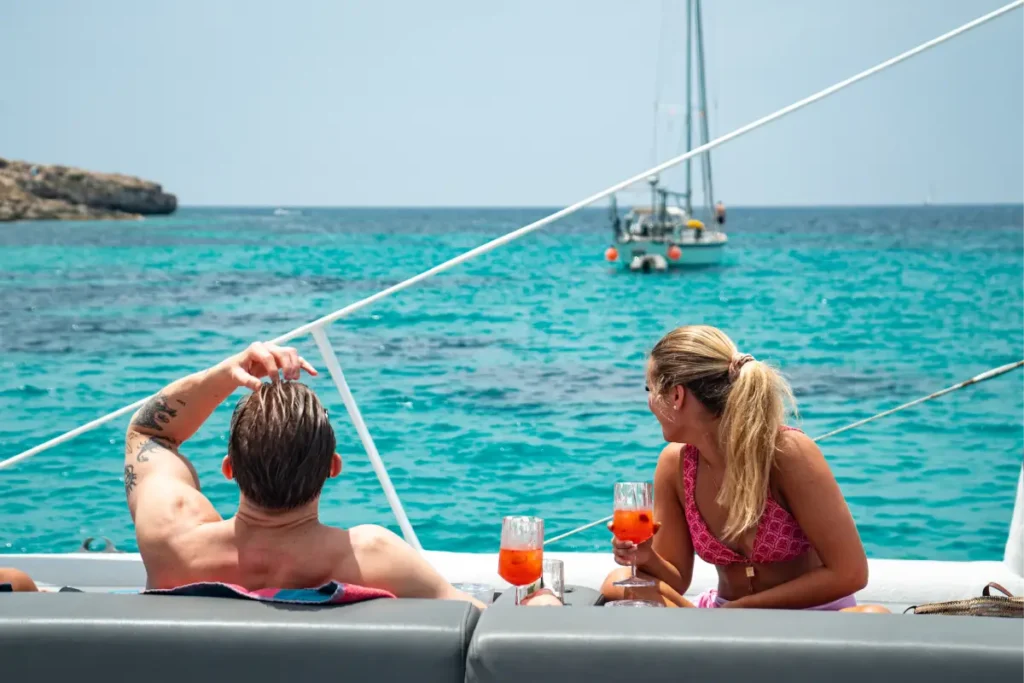
Attraction Catamarans runs a full-day trip that sets sail from Palma at 9:00 a.m., cruises along the island’s south-west coast, anchors off Es Trenc for more than two hours in an authorised area and returns to the Port of Palma at 7:00 p.m. The anchorage is at sea, in front of the beach, respecting the marine reserve regulations, which means access to the sand is by swimming or by tender.
The full itinerary is as follows: departure from Palma at 9:00 a.m., first swim stop at the Cabo Blanco cliffs, main stop at Es Trenc with an anchorage of more than two hours, second stop at Cabo Blanco on the way back and arrival in Palma at 7:00 p.m.
Throughout the day, the food on board follows four moments: welcome drink with Moët & Chandon as you set sail, buffet breakfast during the morning sailing, buffet lunch at the Es Trenc stop and an aperitif on the way back to Palma.
The service also includes towels on board, a DJ atmosphere and a very low ratio of places that guarantees personal attention. It’s not a tourist ferry; it’s a catamaran with limited places and an offer designed so that the full day works as a complete experience, from the first nautical mile to the final berthing.
To help with the final decision, here’s an honest comparison:
Choose the car if you value total flexibility over timing, you’re travelling in a large group (the cost of the parking per person is shared), and you arrive early or late to avoid the parking rush hour.
Choose the bus if you’re travelling alone or as a couple, you don’t want to drive and your transport budget is tight. It demands a bit more scheduling and a walk, but it’s perfectly comfortable if you travel light.
Choose the catamaran if you want the full day to work as a plan in itself, without depending on car parks or bus timetables, with food included and sailing along one of the most beautiful stretches of the south coast. It’s the premium option, and knowingly so.
If you’re still planning the rest of your trip to the island, the article on Mallorca in one week can help you fit Es Trenc into a wider itinerary.
Access to the beach is free. The cost is the parking if you come by car, or the bus ticket.
Yes, there are a few bar and sunlounger rental services on the beach, though the offer is limited to preserve the natural setting. Bringing water and food is always a good idea.
There’s a traditional naturist area integrated into the beach, but the rest of the sands are conventional. They coexist without any problem.
It’s one of the best-preserved beaches in Mallorca. If you’re after nature, clean water and fine sand with no development on the front line, it’s absolutely worth it.
By car, about 15 minutes along a local road. You can also go by bike if your accommodation allows it, since the route is flat and the surroundings are especially pleasant at sunset.