Southern Mallorca holds a promise that many travellers sense but few know how to make real: coves of turquoise water, cliffs of golden limestone and a Mediterranean light that makes any photo look retouched. The problem isn’t finding them — they’re on every list — but knowing which ones truly deserve the effort, when to go to enjoy them calmly and how to organise it without losing half a day between car parks and dirt tracks. This guide is written by the people who sail this coast every week. Take it as advice from a local host with judgement.
The Migjorn — that’s what Mallorcans call the south of the island — is a geographical unit with a character of its own. While the north coast is defined by coves wedged between pines and mountains, and the east piles up more urban, more accessible beaches, the south follows another pattern: white limestone cliffs that drop vertically into the sea, cobalt-blue waters that turn turquoise near the shore and a sense of space that’s hard to find elsewhere on the island.
The Migjorn coastline is also wilder in terms of infrastructure. Few roads reach the coves directly; many of the best are only accessible by unsigned dirt tracks or after walks that not everyone is willing to take on. That, precisely, is what preserves them. And it’s the first thing worth being clear about before deciding on an itinerary.
For a broader perspective on everything this area offers, the guide to what to see in southern Mallorca complements what you’ll find here well.
To plan a day of coves that makes sense, you have to understand the geography from west to east. The southern coastline starts to take shape around Llucmajor, where Cala Pi appears, and extends eastwards past the long tongue of sand of Es Trenc, the unspoilt coves of Es Caragol and Es Caragolet, the iconic Caló des Moro, Cala Llombards, Cala S’Almunia and, already in the transition towards the Llevant, the Mondragó nature park.
This sequence matters because the coves of southern Mallorca aren’t evenly spaced. There are very concentrated areas — Caló des Moro, Cala Llombards and Cala S’Almunia are a few minutes apart by track — and others that are quite far apart, like the jump between Es Trenc and that same group of coves. Trying to string the whole southern strip together in a single day by car without a plan usually ends in frustration. The key is to group by zones.
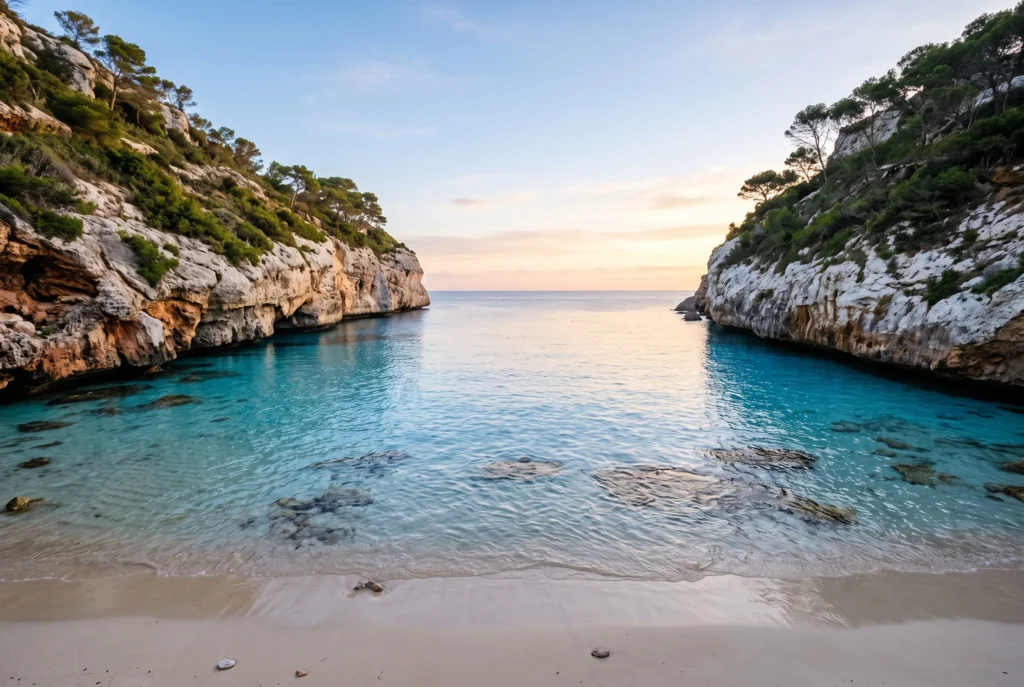
Cala Pi is the westernmost of the group and the most underused in the listings. A narrow strip of dark green water between high cliffs, with steps carved into the rock and natural shade that makes it especially pleasant during the middle of the day. It has parking in the village (with patience), but there’s no beach bar or services. We recommend arriving before nine or after five.
Es Trenc is the great beach of the south: almost three kilometres of fine white sand, shallow, transparent water and a protected setting of dunes and pine woods. It’s important to know that in July and August the official car park fills up before ten in the morning and the beach changes character completely. It has services, sunloungers, beach bars and reasonable accessibility, which also makes it the busiest in the Migjorn.
Es Caragol is another story. No infrastructure, no services, no car possible: you have to park kilometres away and walk over sand and track for almost forty minutes, or arrive by sea. Families with small children usually rule it out once they find out the logistics. Those who make it understand why people come back.
Caló des Moro has its own section further down, because it deserves an honest analysis.
Cala Llombards is one of the best-balanced in the south: acceptable access by car, spectacular water colour, sandy bottom, some shade along the edges and a beach bar. Arriving before ten in summer is the most useful piece of advice we can give you.
Cala S’Almunia is a step away from Llombards by track, but it feels much more tucked away and sheltered. Less known, with very little parking. One of the quieter gems of this stretch.
Cala Mondragó, inside the nature park, combines two connected coves — s’Amarador and Mondragó — with some services and legal protection that has kept it in good condition. It’s suitable for families and has marked accesses from the park car park.
The most practical decision before setting off is based on how much effort your group can or wants to take on. The coves of southern Mallorca divide fairly clearly into two categories.
The most accessible — car close by, parking with some availability, no demanding walk — are Cala Pi, Cala Llombards and Cala Mondragó. All three are a good choice for groups with small children, people with reduced mobility or those who simply prefer not to start the day with a hike.
The ones that demand effort include Es Caragol (long walk over sand), Caló des Moro (walk with a gradient and heavy competition for parking) and Es Trenc in high season (complicated logistics even though the terrain is flat). For these last ones, arriving early or changing the mode of transport — whether boat, bike or taxi from the village — makes the difference.
If your group includes people who prefer to spend the day in the water without logistical worries, the list of best coves in Mallorca to visit by boat gives a useful perspective on what changes when you arrive from the sea.
Caló des Moro is, without question, the most photographed cove in southern Mallorca. An arc of white cliffs, electric-blue water, a bottom visible from the shore. The photo circulates in millions of posts and has turned this spot into a pilgrimage destination for those visiting the island.
What the photo doesn’t show: a narrow dirt track where two cars barely pass each other, a car park that in summer fills up before half past eight in the morning (and where access is closed off when it’s full), a walk of about fifteen to twenty minutes with some gradient under the sun, and a cove that, when running at full capacity, holds many more people than its size comfortably allows.
None of this makes it bad. But it does make it different from what its image promises. If you want to experience it another way, the nearest alternatives — Cala S’Almunia, just a few minutes away, or Cala Llombards — offer equally beautiful water with a fraction of the logistical effort.
The trick if you insist on Caló des Moro: be in the car park before eight in high season, or save the visit for May, June or September, when visitor numbers drop and the experience gets closer to what the image promises.
There are coves in southern Mallorca that, on paper, are accessible by land. In practice, the combination of distance, track, parking and walk turns the logistics into the main event of the day. For these, the boat is simply the most sensible option.
Es Caragol is the clearest example. There’s no road, no services, no shade along the way. Those who arrive on foot celebrate it; those who arrive at anchor experience it in a completely different way: they anchor a few metres out, jump into the water from the boat and swim to a shore that almost always has fewer people than its more accessible neighbours.
Es Trenc in the height of August also falls into this category. The beach is big and the water is magnificent, but the land experience in August has its logistical quirks. Arriving by sea means anchoring in front of the dunes, swimming to the shore and having the beach at the level it deserves.
Cala Vella, inside the Bay of Palma but at the start of the south coast, is practically only accessible from the water. It has its own article with all the details, but the summary is this: few people, clean water and the feeling of having discovered something that doesn’t appear on tourists’ maps.
Cala Blava shares that character of a coastal cove best experienced from the sea, with the added calm of being relatively close to Palma. You can read its full profile here.
Attraction Catamarans’ Es Trenc Excursion sails exactly this stretch — Palma, Cabo Blanco, Es Trenc — with a full day on board and stops in the water. The Sea Day tour skirts the southern bay towards Cala Vella and Cala Blava, with five hours of sailing and catering included.
By month, June and September are the most balanced months for the Migjorn coves: the sea is already warm, the light is perfect and visitor numbers are more manageable than in the height of July or August. May also works very well for anyone who enjoys the scenery as much as the swim.
By arrival time, the rule is consistent along the whole south coast: before ten in the morning in high season. Cala Pi and Mondragó have a bit more leeway. Caló des Moro and Es Trenc in August don’t. For Es Caragol, the time hardly matters because land access is already off-putting in itself.
By day of the week, weekends in July and August concentrate more local and national visitors than weekdays. If your schedule has some flexibility, a Tuesday or Wednesday in August feels different from a Saturday.
By boat, these constraints disappear almost entirely: you set sail with the tide, anchor when it suits and string coves together without depending on car parks or time slots.
Western route by car (Llucmajor–Es Trenc area): Cala Pi first thing, then Es Trenc before the sun is high, and lunch in Ses Covetes or Colònia de Sant Jordi. In the afternoon, when the busiest cove starts to empty, a relaxed return. This route is feasible by car and doesn’t require long walks.
Eastern route by car (Santanyí area): early departure towards Caló des Moro (car park before half past eight), down to the cove, back to the car and on to Cala Llombards for the rest of the morning. In the afternoon, Cala S’Almunia or Cala Mondragó. This route packs three or four coves into a small radius and is the most efficient by land in the eastern Migjorn.
Route from the sea: Palma first thing, sailing towards Cabo Blanco with a stop in the water, anchoring at Es Trenc for two hours and returning with the afternoon wind. It strings together in one day what would take two days and several complicated logistical decisions by land. It’s exactly what the Es Trenc Excursion does.
If the plan is the Bay of Palma with Cala Vella and Cala Blava, the Sunset Tour lets you end the day anchored off the south coast while the sun goes down over Palma, with dinner on board included.

For anyone who wants to string together the most unspoilt coves of the Migjorn without dealing with car parks or walks, the most direct answer is to arrive from the water. Attraction Catamarans’ Es Trenc Excursion covers exactly this stretch: a full day sailing the south-west coast of Mallorca, with a two-hour stop at Es Trenc and swim stops at the Cabo Blanco cliffs. Four food services, a DJ on board and towel service included.
For anyone who prefers to explore the southern bay with Cala Vella and Cala Blava, the Sea Day tour is the alternative: five hours of sailing from Palma, anchoring in crystal-clear waters and catering on board during the crossing.
Both options are the natural way to see this coast when land access is complicated or when you simply want to experience southern Mallorca from the water, which is how this island is enjoyed at its best.
Only at some. Cala Llombards and Cala Mondragó have a beach bar and basic toilets. Es Trenc has several beach bars and full services. Es Caragol, Caló des Moro and Cala S’Almunia have nothing: you have to bring everything.
It depends on the cove and the time of year. Outside high season, the car parks near Cala Pi or Cala Mondragó are usually free. In July and August, the official Es Trenc car parks charge a fee and the ones at Caló des Moro fill up before nine.
Cala Mondragó and Es Trenc are, thanks to their sandy bottom and gradual entry. Cala Pi is too, though without services. Caló des Moro and Es Caragol aren’t the best options because of the walk and the lack of infrastructure.
From the usual car park, between fifteen and twenty minutes with some gradient. It’s not demanding, but with heat and children it can feel long.
Between thirty and forty-five minutes from the nearest parking point, over a sandy track. There’s no shade for much of the route.
May, June and September offer the best balance between water temperature, good weather and more manageable visitor numbers.
Cala Llombards has everything you’re looking for: beautiful water, reasonable access, some services and a human scale that lets you enjoy it without stress.