Mallorca has that rare gift of adapting to any traveller: to the one who arrives with seven days and wants to see it all, to the one who only has five and needs to choose wisely, and to the one looking for the perfect balance with six unhurried but purposeful days.
The largest of the Balearic Islands packs into just 3,600 km² a Gothic cathedral that rivals the finest in Europe, mountain villages declared UNESCO World Heritage Sites, coves with water so turquoise it looks unreal, and a cuisine that goes far beyond pa amb oli.
This itinerary solves exactly that. It’s designed as a pillar article that works just as well for five days as for a full week: it starts with the five-day block — the backbone of any visit — and from there adds the extra stages that let you make the most of a sixth or seventh day without repeating anything.
Five days in Mallorca aren’t a full week, but they’re enough to leave with the feeling of having truly seen the island. The key lies in geographic organisation: grouping by area avoids unnecessary kilometres and lets you arrive at each stop well rested.
The most efficient outline is this: Palma on the first day, the Sierra de Tramuntana on the second, the north on the third, the northeast on the fourth, and the south on the fifth. Each stage stands on its own, and moving from one to the next flows naturally by car — the essential mode of transport for any visit to Mallorca in 5, 6 or 7 days.
What’s left out in five days: Cape Formentor with time to properly enjoy it, the Caves of Drach, and the excursion to Cabrera. Those three gems are exactly what justifies the extra days.
If you have six or seven days in Mallorca, the five-day itinerary stays exactly as it is: you simply add extra stages on the northeast and south sides that feel a bit rushed in the compact version.
The sixth day is perfect for taking your time at Cape Formentor — not just passing through, but with time to go down to Formentor Beach and reach the lighthouse without rushing — or for taking the excursion to the Caves of Drach from Porto Cristo, with the afternoon free at one of the eastern coves.
The seventh day can be dedicated to Cabrera, the uninhabited archipelago south of the island reachable only by boat, whose seabed is among the cleanest in the Mediterranean, or to extending the southern day by adding Cala Llombards and the village of Santanyí. If you’d rather start the week on a different note, Sóller aboard the 19th-century historic train is one of those experiences with no substitute: the route from Palma crosses the mountains, and time seems to stand still over the 28 kilometres of narrow-gauge track.
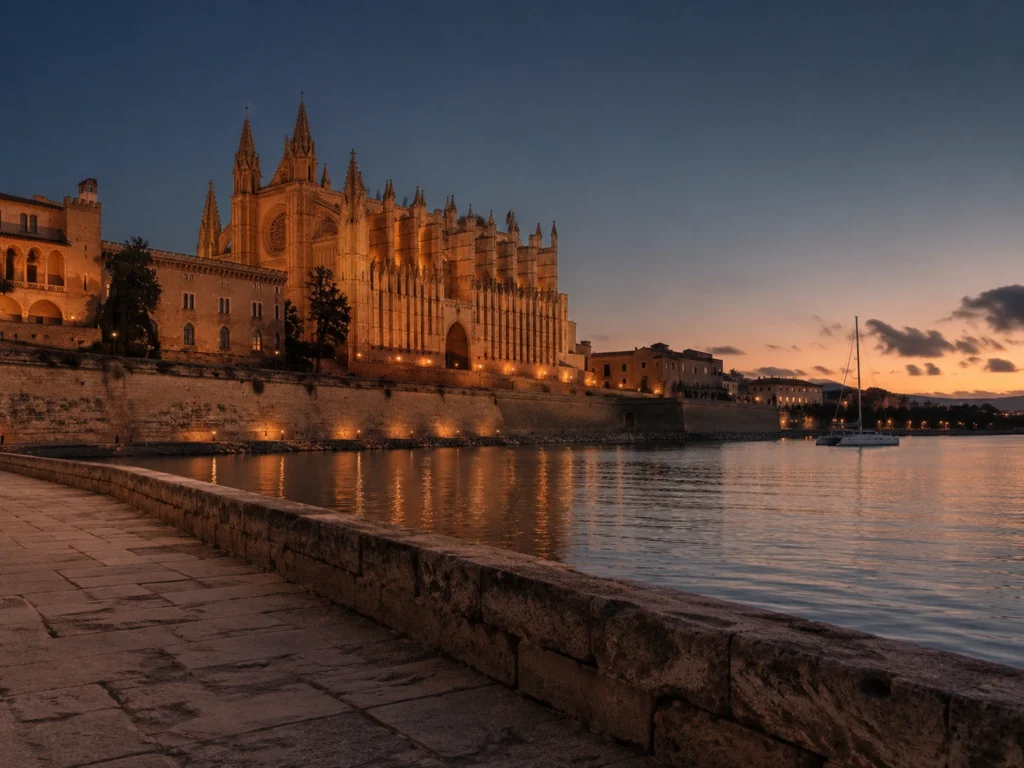
Palma deserves at least a full day, and the best way to start is on foot through the old town before the heat sets in. La Seu — the Gothic cathedral that looks straight out onto the sea — is the first visual impact that defines the trip: its 14,000 m² floor plan and the apse’s rose window, redesigned by Gaudí in the early 20th century, are hard to forget. From the cathedral, the natural route leads to the Almudaina Palace, through the alleys of El Call (the old Jewish quarter), and back to the Palau de l’Almudaina.
In the afternoon, Santa Catalina is the neighbourhood for eating well without the tourist markup: a market, tapas bars, restaurants with local produce. And as the sun starts to go down, the Bay of Palma becomes the best possible stage. If you’re looking for ideas for the evening, some of the best seafront restaurants in Palma are concentrated in this very stretch of the promenade.
That first sunset from the water is, in fact, one of the most memorable moments for anyone spending a week in Mallorca: the city seen from the bay, the cathedral lit up in golden light, is an image you simply can’t get from land.
The Ma-10 road that crosses the Sierra de Tramuntana from south to north is one of the most photogenic routes in all of Spain. The second day begins in Valldemossa, where the Carthusian monastery is where Chopin spent the winter of 1838-39 with George Sand, and where cobblestone streets lined with flowerpots convince anyone that time moves slowly in the mountains.
From Valldemossa, the road leads to Deià: an ochre stone village perched between olive groves and the sea that has drawn writers and artists ever since Robert Graves made it his home in the 1930s. The Sa Foradada viewpoint, with its rock that opens onto the Mediterranean like a natural window, is the perfect halfway stop. The day can wrap up in Sóller, with its fishing port and arcaded square, or you can save the historic train experience from Palma for a more relaxed start the following day.
Northern Mallorca combines medieval history and extreme nature in a single day. Pollença starts with the Calvari — 365 steps up to a chapel with panoramic views — and continues to the main square, where the Sunday market (if your timing lines up) is one of the most authentic on the island. Alcúdia adds well-preserved medieval walls and the widest bay in the northeast.
From Alcúdia, the road to Cape Formentor is the one that shows up most often in travel magazines when they talk about a week in Mallorca: curves along the cliffside, maritime pines, the white lighthouse at the end, and just before it, the Colomer viewpoint with the most dramatic panorama on the island. If you only have five days, this stage can be trimmed a little; if you have six or seven, Formentor deserves the full day.
Northeastern Mallorca is the least developed and most authentic part of the interior. Artà has a character all its own — its walled citadel on the hilltop, with the Church of the Transfiguration and the Sant Salvador sanctuary, overlooks a village that still lives largely untouched by mass tourism. Capdepera adds another medieval castle with views of Menorca on clear days.
The afternoon visit is the Caves of Drach, in Porto Cristo: four vast caverns of stalactites and stalagmites that lead down to Lake Martel, one of the largest underground lakes in the world. The classical music concert on the water — the musicians float by in a small boat as they play — is one of those moments that leaves a lasting mark on any week in Mallorca.
Southern Mallorca is a different world altogether: without the verticality of the mountains or the grandeur of Palma, its treasure is the colour of the water. The fifth day is designed to let you lose yourself among the coves and beaches with the most turquoise waters on the island.
Caló des Moro is small, tucked between rocks and reachable on foot from a car park — it’s worth arriving before nine if you’re visiting in high season. Es Trenc is the opposite: two kilometres of fine sand and lagoon-like water stretching out undeveloped, with a few low-key beach bars at either end. Cala Mondragó, within the nature park of the same name, combines two coves with pine woods and far less crowding than the rest of the south. Ending the day watching the sun set over the sea from any of these spots is the perfect way to close out a trip to Mallorca in 5, 6 or 7 days.
If you’re looking to make that final sunset something even more special — especially if you’re travelling as a couple — exploring the best couples’ plans in Mallorca can give you ideas that go well beyond the beach.
A rental car isn’t optional: Mallorca has public transport between the main towns, but the coves in the south, the viewpoints of the Tramuntana and the inland villages are practically inaccessible without your own vehicle. Booking weeks ahead in high season (June-September) avoids nasty surprises on price and availability.
As for where to base yourself, there are two strategies: staying in Palma for the whole week and driving out each day (convenient, with easy access to dining and nightlife), or splitting your stay across two bases — Palma for the first days, Pollença or Port de Sóller from the third day onward — to cut down on driving. If the goal is to see Mallorca in 5 days at an efficient pace, Palma as a single base is the most practical option.
The best time to visit the island is May, June and September: the sea is already warm, the coves aren’t at the peak crowding of July and August, and the light during those weeks has a special quality. To avoid the crowds at the most popular spots — Formentor, Caló des Moro, Valldemossa — the rule is simple: head out before nine in the morning or arrive after five in the afternoon.
Mallorca isn’t an island to rush through. But with a well-planned itinerary — whether five, six or seven days — each day stands on its own, and together they add up to a complete, honest picture of what the island really has to offer. The one mistake worth avoiding is trying to see it all in too little time: two coves truly enjoyed beat five seen from the car window.