The villages of northern Mallorca are small towns located in the Serra de Tramuntana and the northern coast of the island, known for their mountain landscapes, historical heritage, and proximity to the sea. This area brings together villages such as Alcúdia, Pollença, Sóller, Deià, Fornalutx, Artà, or Capdepera, all of which are staples in travel guides and specialized blogs about the Balearic Islands.
The Serra de Tramuntana, declared a UNESCO World Heritage site, serves as the backdrop for many of these villages and defines their character: cobblestone streets, stone architecture, viewpoints overlooking the Mediterranean, and a gastronomic offer linked to local products. The recommended time to visit them spans from May to October, although each season offers different nuances regarding visitor numbers and weather.
In this guide by Attraction Catamarans on the villages of northern Mallorca, you will find a clear description of each locality, its relationship with the sea, and options for discovering the coast by catamaran.
Beyond the official data, northern Mallorca is that stretch of the island where the mountains literally fall into the sea. The Serra de Tramuntana plunges directly into the Mediterranean, creating dizzying cliffs, hidden coves, and breathtaking viewpoints. Here, among centuries-old pines and crystal-clear waters, you will find the authentic Mallorca—the one that appears in Instagram photos but, once you arrive, you discover is much more than a postcard. Some days, the road feels more like an excuse to keep stopping than a way to arrive quickly.
Northern Mallorca mainly covers the Serra de Tramuntana region and part of the island’s northeast coast. It includes both inland villages and coastal towns and natural harbors. The most prominent municipalities are Alcúdia, Pollença, Sóller, Deià, Fornalutx, Artà, and Capdepera, along with other smaller hubs like Escorca or Estellencs.
Geographically, this area combines the Tramuntana mountain range with two large bays—the Bay of Alcúdia and the Bay of Pollença—and numerous coves that are difficult to access by land. The distance between villages is relatively short: you can drive the coast from Alcúdia to Sóller in approximately one and a half hours, although this depends on the day and traffic.
In practice, northern Mallorca is that part of the island where the mountains aren’t satisfied with just being scenery. They get into the sea, break the coastline, and create nooks and crannies. There are days when the coastal road feels like an engineering whim, winding between pines and cliffs. On other days, you simply surrender and accept that you’ll take twice as long as planned because every five minutes there is a viewpoint, a little village, or a curve with views that force you to stop.
Although many describe the north of Mallorca as the quietest part of the island, there are days when reality looks more like a small pilgrimage by the sea, and that’s okay. It’s part of the package.
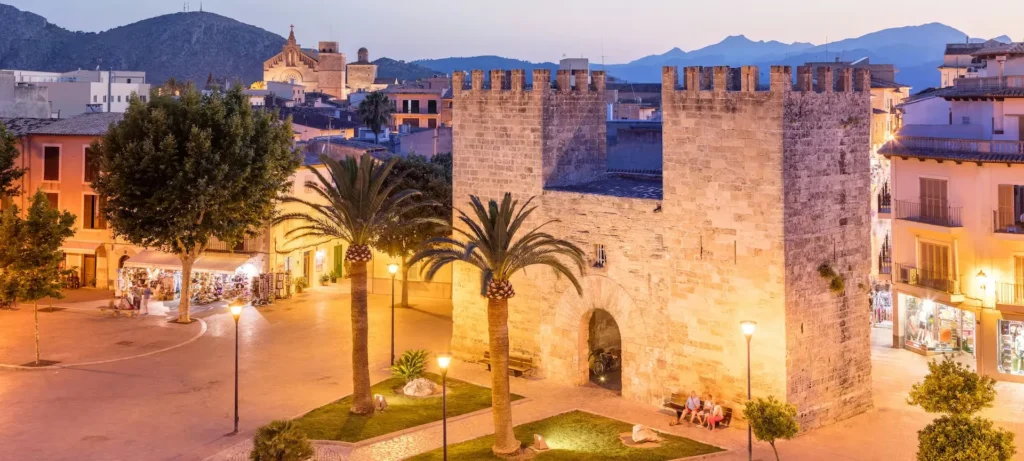
Alcúdia is a municipality in northern Mallorca located between the Bay of Alcúdia and the Bay of Pollença, known for its medieval walls and nearby fine sand beaches. The historic center is surrounded by a virtually intact wall dating back to the 14th century, containing narrow pedestrian streets, squares with terraces, and stone buildings.
Its historic center is small but very compact—the kind you can walk through in an hour and still feel like you missed a street. On market days—Tuesdays and Sundays—the squares fill with stalls of fruit, cheese, and flowers, and the town changes its pace. People move slower, stop to talk, and buy tomatoes as if it were a social act.
Alcúdia also serves as a gateway to the Formentor peninsula and some of the best beaches in northern Mallorca: Playa de Muro, with its kilometers of white sand, and Playa de Alcúdia, which is more family-oriented with all services. From Alcúdia and Port de Pollença, the northern coast opens into two wide bays perfect for sailing; they are ideal spots to combine a walk through town with a catamaran excursion.
While you explore these villages, Attraction Catamarans proposes a counterpoint from the water: catamaran tours and charters with a skipper to see the coast from the outside, from the Mediterranean, with a different light and a different silence.
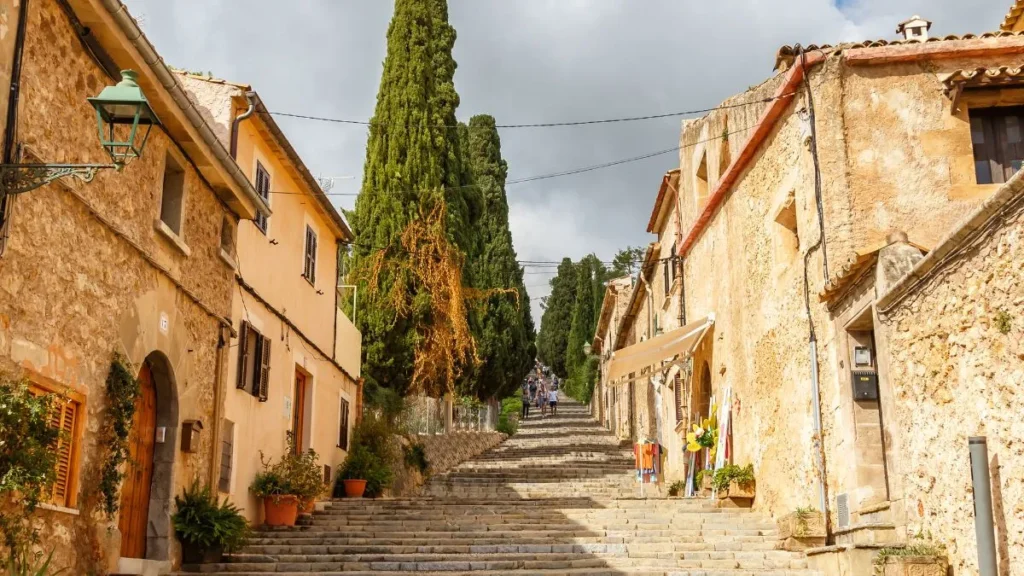
Pollença is an inland town located at the foot of the Serra de Tramuntana, about 6 kilometers from the coast, known for its artistic atmosphere, its Sunday market, and the Calvari steps, which feature 365 steps. The Plaza Mayor is the heart of the village, surrounded by bars and restaurants with terraces shaded by plane trees.
Port de Pollença, its coastal hub, is a protected natural harbor with a long promenade, calm water beaches, and a wide range of nautical activities. Here, the rhythm is different: more touristy, more open, with a mix of families seeking quiet beaches and people renting kayaks or paddleboards to explore the bay.
The interesting thing about Pollença is that it forces you to choose. Either you spend the morning climbing the Calvari—and believe me, you feel every step—only to come down for a drink in the square, or you go straight to the port and forget about exercising. There is no middle ground. Well, actually, there are people who do both in the same day and then wonder why they are exhausted.
From Port de Pollença, you can easily access Cala Sant Vicenç and Cape Formentor by car, two of the most photographed areas in the north. It is also a great starting point for boat trips to coves that are less accessible from land, something we at Attraction Catamarans take advantage of in our routes through the Bay of Palma and other areas of the northern coast.
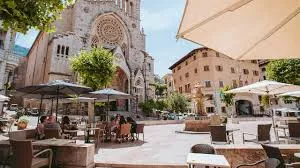
Sóller is a municipality located in a valley surrounded by mountains and orange groves, connected to Palma via a historic train dating back to 1912. The Plaza de la Constitución is the heart of the town, with the Sant Bartomeu church as its most prominent building and numerous cafés and ice cream parlors under the arcades.
Port de Sóller, about 4 kilometers from the town center, is a horseshoe-shaped natural harbor with a beach, promenade, and a protected bay that has historically served as a refuge for vessels. From here, you can access coves like Sa Calobra or Cala Tuent by car or boat—two of the most spectacular in the Tramuntana, though also among the busiest in high season.
The Sóller train is an experience in itself, yes, but it is also slow, and after half an hour of staring at orange trees through the window, you start to understand why some people prefer the car. However, upon arriving and stepping off at that station that looks like it belongs to another era, you get over it. If you want to complete the “vintage” package, you can take the wooden tram that runs from Sóller to the port. It takes fifteen minutes. By car, it’s five. But it’s not the same.
Port de Sóller has something special at sunset: the light enters the bay from the side, and the mountains grow darker while the water turns orange. It is one of those moments where you look around and think: “Okay, this is why I came.” Attraction Catamarans offers sunset tours specifically to capture that light from the sea, sailing slowly through the Bay of Palma toward Cala Vella, with catering on board and the chance to swim as the sun goes down.
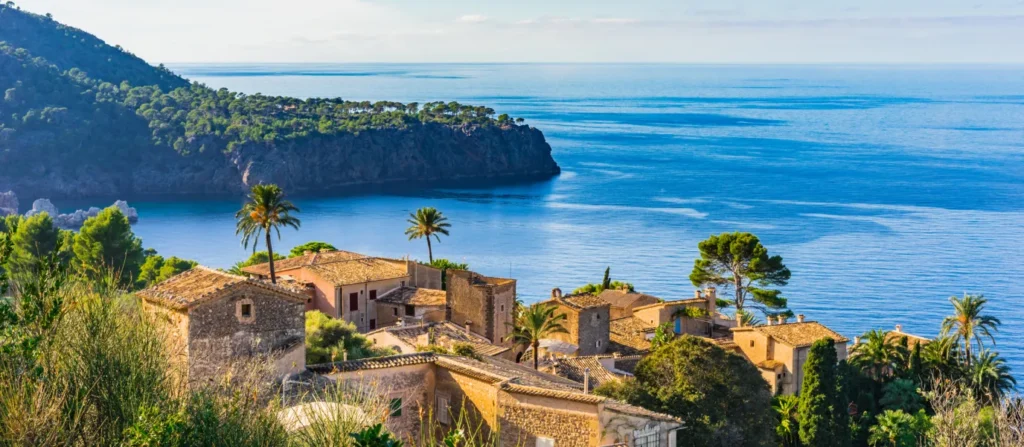
Deià is a small village perched on a slope of the Tramuntana with sea views, known for its community of artists and writers—Robert Graves lived here for decades—and for a peaceful atmosphere that contrasts with the mass tourism of other areas. The streets are narrow and steep, with stone houses and gardens peeking over walls.
Fornalutx, just a few kilometers away, is considered one of the most picturesque villages in Spain according to several travel guides. It is nestled in a valley surrounded by olive and orange trees, with cobblestone streets, flowerpots on facades, and an almost surreal “postcard village” air. It is small—you can walk through it in twenty minutes—but it has that quality of making you walk slowly, almost without realizing it.
Deià has a beach, Cala Deià, although you have to walk down a somewhat steep path, and the cove itself is rocky and small, with a couple of beach bars (chiringuitos) that are packed in summer. It’s not your typical towel-and-umbrella beach; it’s more of a “I’ve come to swim, eat, and leave” kind of place. It works.
Fornalutx, on the other hand, has no coast. It is tucked into the mountain. But precisely for that reason, many visitors combine it with a trip to the sea afterward, either by heading down to Sóller or booking a catamaran trip to balance all that stone and green with a couple of hours of crystal-clear water. Attraction Catamarans organizes catamaran experiences designed for groups, couples, and families—yes, families too—with the option to rent a private catamaran with a skipper if you are looking for something more exclusive.
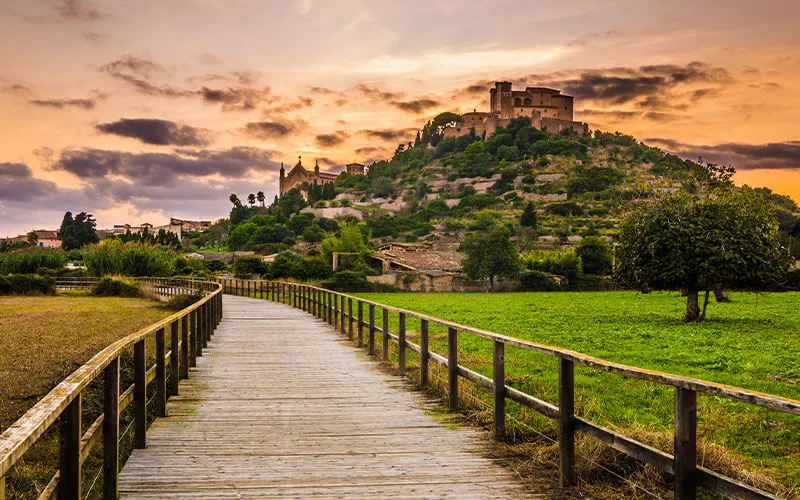
Artà is a town in northeast Mallorca, about 15 kilometers from the coast, known for its Sanctuary of Sant Salvador—visible from various points in the municipality—its weekly market, and a slightly more bohemian and less touristy vibe than other northern villages. The streets of the old town slope upward toward the sanctuary, and from the upper esplanade, there are wide views of the countryside and the coast.
Capdepera, further east, is a walled town with a medieval castle at the top that is very well preserved. The medieval market held in May recreates ancient trades and attracts many visitors. Cala Rajada, Capdepera’s coastal hub, is an area of beaches and coves with a more youthful atmosphere and nightlife options.
Artà has something that is hard to explain. It is not strictly the “prettiest” village in northern Mallorca, but it has personality. There are art galleries, ceramic shops, and bars where locals mix with visitors without it feeling forced. On market days—Tuesdays—things liven up: stalls selling clothes, tools, olives, a bit of everything.
Capdepera is a different story. The castle at the top, the streets at the bottom, and that feeling that the town was built for walking up and down hills. If you arrive in the middle of August and it’s hot, you might think twice before climbing to the castle. But once you’re up there, the views make it worth it: you see the coast, the coves, and Menorca on clear days. Then you head back down, grab a shaded terrace, and you’re set.
Every village in northern Mallorca is associated with a beach or cove that can be visited on the same day. Some are accessible by car and foot, while others require longer hikes or, quite simply, arriving by boat. Here are the most common pairings:
A typical day in the middle of August can include traffic, full parking lots, and hikes in the sun that are longer than expected. In coves like Coll Baix or Cala Bóquer, walking is the only land option, and in summer, that means trekking under the sun with a backpack, towel, and water, arriving sweaty. Once you get in the water, you forget about it, but the hike back is still there.
That is why many of these coves are best enjoyed by boat. No hiking, no rushing, and the possibility of moving from one cove to another in the same morning. Furthermore, from the sea, you see the coast differently: the cliffs, the entrances to the coves, and the colors of the water changing with the depth.
If you want to dive deeper into the best beaches in the area, you can consult our guide to the beaches of northern Mallorca, where we detail access, services, and characteristics of each.
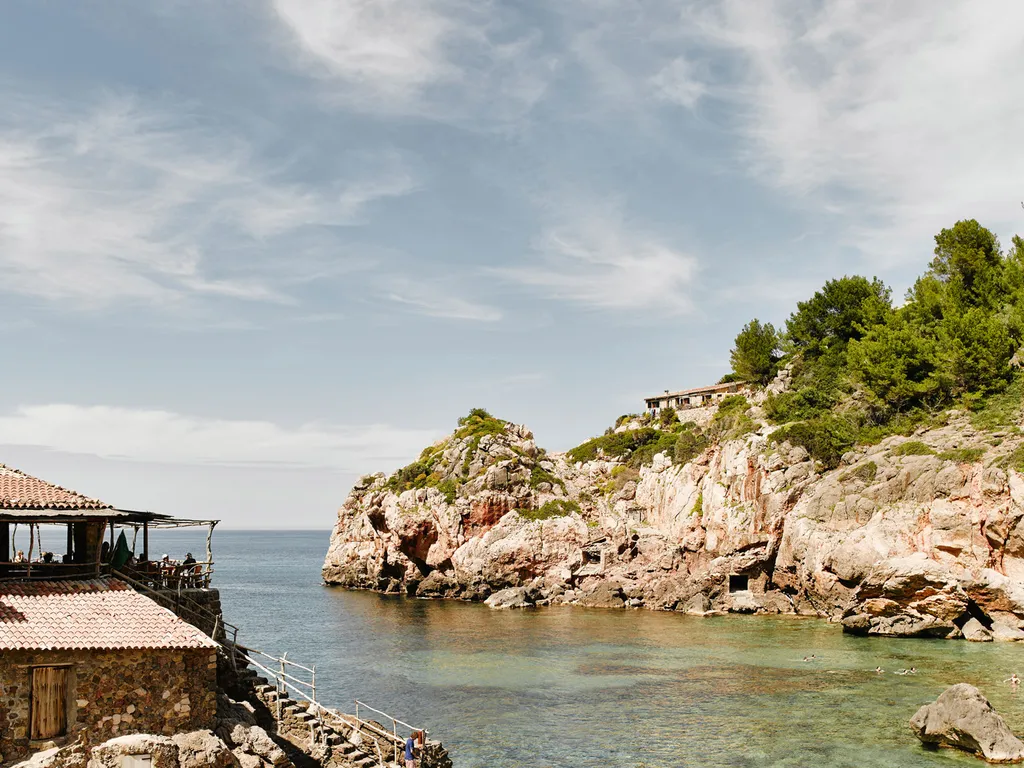
At Attraction Catamarans, we organize daytime and sunset catamaran tours toward Cala Vella, sailing through the Bay of Palma, with catering on board, the chance to swim and snorkel, and a crew that knows the coast well. We also offer the option of catamaran rental with a skipper for private groups: corporate events, weddings, family celebrations, bachelor/bachelorette parties, or gatherings with friends. Whatever you need.
The idea is simple: combine visiting the villages in the morning—Alcúdia, Pollença, a market, a wall—with a catamaran tour in the afternoon or at sunset the following day. Or vice versa. Or leave a full day for resting on a catamaran, without a car, without a watch, and without having to decide which cove to go to because you are already on the water.
If you prefer something more private, renting a catamaran with a skipper allows you to design your own route. You can celebrate a birthday, host a party, go out with coworkers, or simply spend the day with family without being disturbed. The catamaran is yours, the skipper handles the navigation, and you decide if you want music, if you want to stop to swim in three different coves, or if you prefer to just sail and chat with a beer in hand.
It is no coincidence that many groups visiting northern Mallorca end up booking a catamaran experience after a few days of touring villages. It’s the contrast: after walking, climbing stairs, and taking photos at viewpoints, you just want to let go. And the sea, from a catamaran, does exactly that: it carries you.
If after seeing walls, markets, and viewpoints you want to see northern Mallorca from another angle, Attraction Catamarans makes it easy: you can book a spot on our day or sunset tours or request a quote for a private catamaran. Then, decide on the fly if the plan is to celebrate something big or simply disconnect for a few hours.
We recommend dedicating between 3 and 5 days if you want to combine villages, coves, and a sailing day. With 3 days, you can see the main villages (Alcúdia, Pollença, Sóller) and enjoy a beach. With 5 days, you can add Deià, Fornalutx, Artà, and an excursion by catamaran or to more remote coves.
You need a car. Public transport exists, but frequencies are limited, and the distances between villages and coves make depending on the bus impractical. Renting a car gives you the freedom to move at your own pace, stop at viewpoints, and change plans.
Many guides recommend June and September as the ideal months: good weather, less crowding than July and August, and slightly lower prices. However, some prefer October: less heat, fewer people, and that lower light that makes the mountains seem closer. There is no perfect month for everyone. If you go in the middle of August, expect more traffic, more people on the beaches, and full parking lots at the main coves. It’s not a tragedy, but you should be aware.
In high season (July and August), it is wise to book activities like catamaran tours, restaurants with views, and accommodation well in advance. Popular coves like Formentor have limited parking in summer and fill up before 10:00 AM. If your plan includes a boat trip, booking with Attraction Catamarans a few days prior ensures your spot and avoids surprises.
The middle of the day in summer (1:00 PM – 5:00 PM) is harsh for walking through villages without shade or hiking. It is better to take advantage of the early morning or late afternoon. It is also best to avoid the most tourist-heavy roads (like the one to Sa Calobra) during peak hours if you don’t like traffic jams.
For more information on what to see in the area and how to organize your route, check out our complete guide to northern Mallorca, where we expand on routes, viewpoints, activities, and local tips.
Northern Mallorca is not a destination for just one day or one single experience. It is meant to be taken slowly—switching between villages, coves, and plans. See the walls of Alcúdia in the morning, swim in Formentor at noon, and climb Pollença’s Calvari at sunset. And the next day, hop on a catamaran with Attraction Catamarans and see it all from the outside, from the water, with that perspective that only the sea can provide.
If you found this guide useful, on the Attraction Catamarans blog, you will find more content about Mallorca: coastal routes, beach and cove guides, tips for organizing boat excursions, and experiences from the sea that complement any visit to the island. There, we try to share what actually works when you combine land and water, villages and sailing. Take a look when you have a moment; there is always a new plan that might fit what you’re looking for.